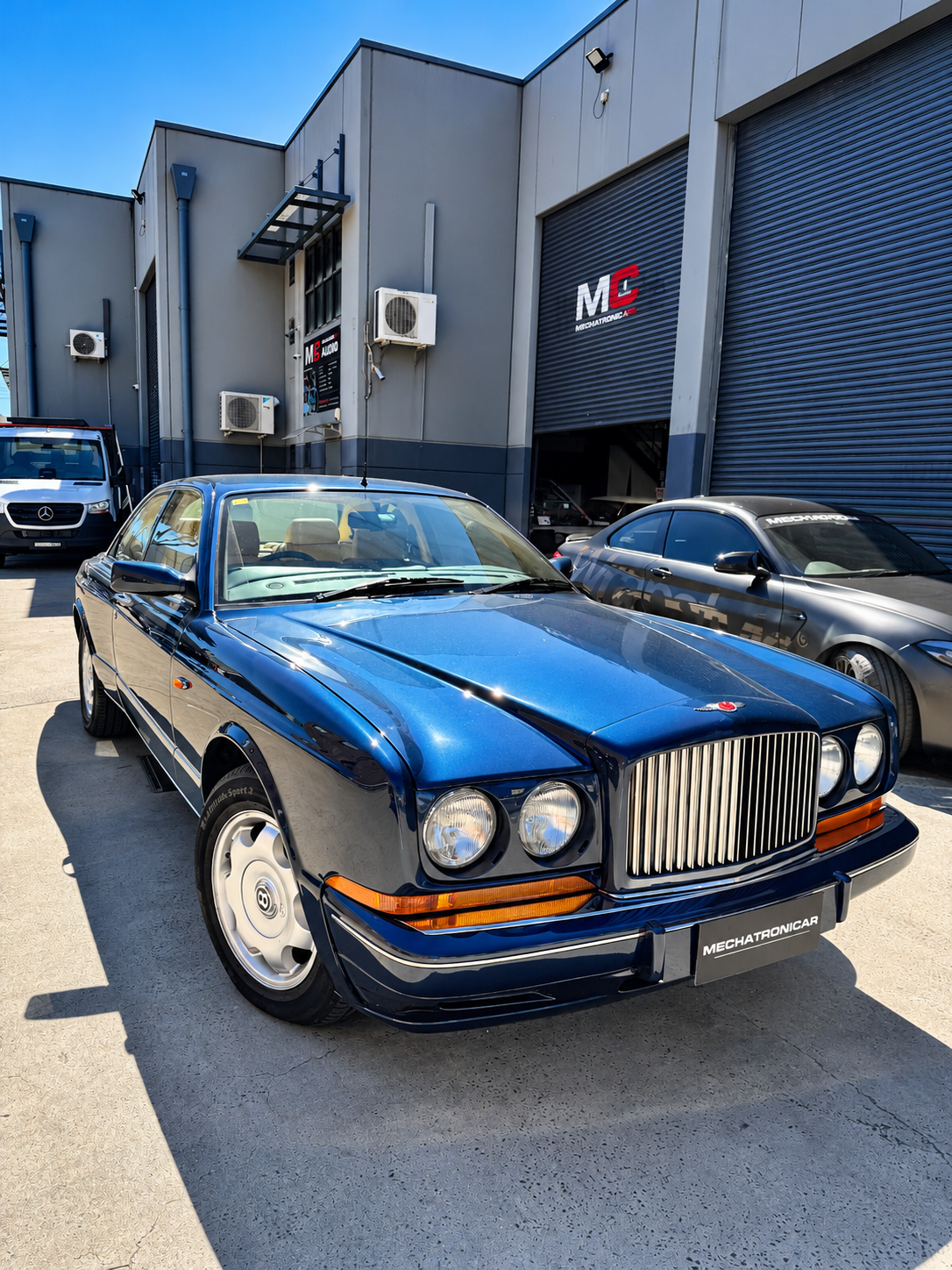
1992 Bentley Continental R High-End HELIX Ci7 Audio Upgrade in Sydney
There are cars where an audio upgrade is simply about making the music louder.
A 1992 Bentley Continental R is not one of them.
This car represents a very different era of automotive design. Heavy doors, extensive insulation, handcrafted timber, leather throughout the cabin and an interior designed around refinement rather than technology.
So when this Continental R arrived at MC Audio Australia in Sydney, our objective was not simply to install new speakers and an amplifier.
The challenge was to build a genuinely high-end modern audio system while making sure the Bentley still looked and felt like a Bentley.
The final system combined a Pioneer period-style head unit, HELIX Ci7 speakers, HELIX NEXT V EIGHT DSP ULTIMATE amplifier, HELIX 10-inch subwoofer, HELIX CONDUCTOR, extensive acoustic treatment and professional DSP tuning.
And getting there required considerably more work than the equipment list might suggest.

The Vehicle
Vehicle: 1992 Bentley Continental R
Project: Complete high-end sound system upgrade
Location: MC Audio Australia, Sydney NSW
Installation time: Approximately 6 days
Main audio platform: HELIX
DSP amplifier: HELIX NEXT V EIGHT DSP ULTIMATE
Speaker range: HELIX COMPOSE Ci7
Subwoofer: HELIX IK ES10.1-DVC2 MK2 10-inch
Head unit: Pioneer SXT-C10PS
Acoustic treatment: Doors and rear panel areas
Final calibration: MC Audio professional DSP tuning
How This Bentley Continental R Project Started
Craig originally contacted us after being referred by another MC Audio customer whose Jaguar we had previously worked on.
The Bentley had already undergone an audio upgrade elsewhere.
His mechanic had installed an inexpensive modern Alpine Bluetooth head unit along with three pairs of Rockford Fosgate speakers.
Unfortunately, Craig was not happy with the result.
Visually, the modern head unit looked completely out of place amongst the timber and traditional Bentley dashboard.
More importantly, the sound itself was not enjoyable.
Craig explained that after listening for around 20 minutes he would begin experiencing listening fatigue and almost a headache.
That immediately told us that simply replacing another component was unlikely to solve the problem.
The entire system needed to be considered as one.
What Did the Owner Want From the New Sound System?
Craig previously owned a Mercedes-Benz S-Class Coupé equipped with a Burmester audio system, so he already had a strong reference for what a refined premium system could sound like.
His expectations for the Bentley were clear.
He wanted:
- More clarity
- Better vocal reproduction
- Stronger and deeper bass
- Better dynamics
- Higher usable volume
- Improved soundstage
- Less listening fatigue
- A balanced overall presentation
- Modern connectivity
- An installation appropriate for a rare classic Bentley
Most importantly, he did not want the car filled with obviously modern-looking audio equipment.
That last requirement shaped the entire installation.
The Complete Audio System Installed
The final Bentley Continental R sound system included:
Source
1 × Pioneer SXT-C10PS
DSP amplification and system control
1 × HELIX NEXT V EIGHT DSP ULTIMATE
8-channel amplifier with 12 high-level inputs and integrated 14-channel DSP
1 × HELIX CONDUCTOR Control Input
Programmable LED remote control for compatible HELIX and MATCH DSP systems
Front sound stage
1 × HELIX Ci7 W165FM-S3
6.5-inch high-end midbass woofer pair, FlexMount, 3Ω
1 × HELIX Ci7 T20FM-SC
0.75-inch high-end tweeter pair, FlexMount, 4Ω
Rear speakers
1 × HELIX Ci7 C165.2FM-S3
6.5-inch 2-way high-end coaxial speaker pair, FlexMount, 3Ω
Low-frequency system
1 × HELIX IK ES10.1-DVC2 MK2
10-inch 300W RMS vented subwoofer bench enclosure, dual 2Ω
Installation hardware
6 × HELIX FlexMount components
Acoustic treatment
Doors and rear panels sound deadening and acoustic treatment
Calibration
1 × Professional DSP tuning session
This was not a conventional speaker replacement.
The system was designed as a complete acoustic package.
Choosing a Head Unit That Actually Belonged in a 1992 Bentley
One of the most important decisions had nothing to do with amplifier power.
It was the head unit.
Craig specifically asked us to be careful here.
He did not want a touchscreen or something that immediately announced:
“This was installed 30 years after the car was built.”
And we agreed completely.
The original Bentley radio suited the dashboard visually, but it lacked the functionality Craig wanted and was no longer the ideal source for the system we were planning.
The recently installed Alpine unit provided newer features, but aesthetically it simply did not belong.
We therefore researched alternatives with two requirements:
- The radio had to visually complement the Bentley.
- It needed to provide a suitable modern source for the new HELIX audio system.
We ultimately chose the Pioneer SXT-C10PS.
Its restrained, retro-inspired appearance worked much better with the Continental R interior while still giving the system modern functionality and connectivity.
That combination was critical.
In a classic luxury vehicle, good integration is not simply about whether something physically fits.
It has to look correct.

HELIX Ci7 Front Speaker System
For the front stage we selected components from the HELIX COMPOSE Ci7 range.
The system uses:
HELIX Ci7 W165FM-S3
The 6.5-inch Ci7 W165FM-S3 midbass woofers were used to provide the foundation of the front sound stage.
Midbass is one of the areas where many systems struggle.
Without a strong transition between the subwoofer and front speakers, the system can sound impressive in the bass but thin through the lower vocals and instruments.
The Ci7 midbass drivers gave us the platform needed to build a much more substantial front stage.
HELIX Ci7 T20FM-SC
For the high frequencies we installed the HELIX Ci7 T20FM-SC 0.75-inch tweeters.
With DSP control, the tweeters could be calibrated independently rather than relying solely on passive speaker filtering.
That allowed us to concentrate on what Craig specifically wanted:
detail without harshness.
This was particularly important because listening fatigue was one of the biggest complaints with the previous installation.

HELIX Ci7 Rear Speaker Upgrade
The rear stage uses the:
HELIX Ci7 C165.2FM-S3 6.5-inch 2-way high-end coaxial speaker pair.
Rear speakers in a high-end system need to be treated differently from the front stage.
The objective is not to pull the music behind the listener.
Instead, they can be used to provide controlled rear fill and a greater sense of space while allowing the front stage to remain the main focus.
The HELIX DSP gave us the ability to integrate the rear channels into the overall tuning rather than simply allowing them to play at full level.
Why We Chose the HELIX NEXT V EIGHT DSP ULTIMATE
At the centre of the system is the:
HELIX NEXT V EIGHT DSP ULTIMATE
This unit combines an 8-channel amplifier with a 14-channel DSP platform.
For a build like this, DSP is fundamental.
The speaker positions inside a 1992 Bentley were never designed around modern high-end audio principles.
The driver sits significantly closer to some speakers than others.
Speaker angles are different.
The distance between the listener, woofer and tweeter varies substantially.
And the acoustic properties of a large luxury cabin create their own challenges.
Without DSP, all of those compromises remain part of the final sound.
With DSP, we can work with each channel individually.

What Does DSP Tuning Actually Do?
Digital signal processing allowed us to calibrate parameters such as:
- Individual speaker levels
- Time alignment
- Crossover frequencies
- Equalisation
- Frequency response
- Subwoofer integration
- Front-to-rear balance
- Tonal balance
- Phase relationships
- Soundstage positioning
Instead of every speaker simply playing simultaneously, the system can be calibrated so the sound arriving at the driver's position is significantly more coherent.
The goal is for the listener to stop hearing individual speakers.
You should hear music positioned across the front of the vehicle.
That is one of the biggest differences between installing premium equipment and actually building a premium sound system.
Keeping the Amplifier Hidden
Fortunately, the Continental R gave us more physical space than many modern vehicles.
But Craig was very clear that he did not want audio equipment unnecessarily displayed around the car.
The Bentley originally had an amplifier installed in a dedicated area.
Rather than introducing a new visible amplifier rack into the boot, we used the original amplifier area to integrate the new HELIX electronics as discreetly as possible.
This is exactly the type of installation philosophy we prefer at MC Audio.
If premium equipment can be integrated without affecting the original appearance or usability of the vehicle, that is normally the better solution.
The technology is there to be heard.
It does not necessarily need to be seen.
HELIX CONDUCTOR DSP Controller
We also installed the HELIX CONDUCTOR Control Input.
The CONDUCTOR is a compact programmable controller that communicates directly with compatible HELIX DSP equipment.
It gives the driver convenient access to selected audio functions without needing to connect a laptop to the processor.
For a car where maintaining a discreet interior was extremely important, a compact controller made much more sense than adding another large display or control panel.

The Bass Challenge in a Bentley Continental R
The Continental R presents an interesting challenge when designing the subwoofer system.
The cabin is extremely well insulated from the luggage compartment.
Normally, that is fantastic.
It is one of the reasons this type of vehicle feels so quiet and isolated from the outside world.
For car audio, however, that isolation works both ways.
Bass generated inside the boot has to make its way through the substantial construction and insulation separating the luggage area from the passenger cabin.
When we first discussed the project with Craig, he understandably wanted us to use as little boot space as possible.
However, we explained that going too small with the bass system would compromise the result.
For this particular vehicle we needed a subwoofer capable of producing sufficient low-frequency energy while remaining controlled and musical.
HELIX IK ES10.1-DVC2 MK2 10-Inch Subwoofer
We selected the:
HELIX IK ES10.1-DVC2 MK2
This is a 10-inch, 300W RMS vented subwoofer enclosure with dual 2Ω voice coils.
We have used this HELIX enclosure on a number of projects and particularly like how it performs when we have sufficient space to allow it to work properly.
On some vehicles, packaging restrictions force us towards extremely compact bass solutions.
The Bentley gave us more freedom.
That meant we could choose the subwoofer based more heavily on performance rather than simply physical dimensions.
For this project, that was a major advantage.
The objective was not exaggerated or boomy bass.
It was to create genuine low-frequency extension that could keep up with the Ci7 front stage and overcome some of the Bentley's natural acoustic isolation.

Why a Bigger Subwoofer Solution Was Necessary
When a vehicle has a heavily insulated passenger compartment, using a tiny subwoofer simply because it is easy to hide can become a false economy.
The system may look tidy but never achieve the required low-frequency authority.
The Continental R needed enough bass output to enter the passenger cabin while still retaining definition.
At the same time, we did not want the subwoofer to sound like an independent speaker sitting in the boot.
During DSP tuning, considerable attention was therefore given to blending the HELIX IK ES10.1-DVC2 MK2 with the front midbass drivers.
When correctly integrated, you should not immediately identify where the subwoofer is located.
The bass simply becomes part of the music.
Sound Deadening Was a Major Part of the Build
This is one of the areas of the installation that photographs rarely communicate properly.
We spent approximately two days on the acoustic treatment alone.
The doors and rear panel areas were treated before the new speakers were finally installed and calibrated.
You might reasonably ask:
Why add sound deadening to a Bentley that is already extremely quiet?
Because road-noise insulation and loudspeaker acoustic treatment are not exactly the same thing.
The Bentley cabin was already impressively isolated from external noise.
However, when a modern high-performance midbass driver is installed into a large door, it can transfer considerably more energy into the structure than the original system.
Untreated metal and trim can resonate.
That wastes speaker energy and colours the sound.
Acoustic treatment helps create a more stable environment for the speaker.
What Does Door Sound Deadening Improve?
In a properly designed audio installation, door treatment can help with:
- Stronger midbass
- Better bass definition
- Reduced panel resonance
- Less vibration
- Improved speaker efficiency
- Cleaner transient response
- Better separation between instruments
- Lower perceived distortion
It is not simply about making the vehicle quieter.
It is about creating a better acoustic enclosure around the speaker.
On a system at this level, we considered that work essential.

Six HELIX FlexMount Components for Proper Speaker Integration
The installation also incorporated six HELIX FlexMount components.
One of the advantages of the HELIX COMPOSE ecosystem is the ability to integrate high-performance speakers into existing vehicle locations without unnecessarily redesigning the entire interior.
For a rare Bentley, that was particularly valuable.
We wanted to use the original installation areas wherever practical rather than cutting visible sections of the interior simply to accommodate aftermarket speakers.
That approach allowed us to preserve far more of the original character of the car.

Two Days Just to Carefully Disassemble the Bentley
Perhaps the most challenging part of this installation was not electronic at all.
It was taking the vehicle apart.
We spent approximately two days carefully disassembling the relevant interior areas.
There is very little readily available installation information for a 1992 Bentley Continental R.
And replacement parts are nothing like ordering a trim clip for a late-model Toyota.
Some interior components for these vehicles are extremely difficult, expensive or practically impossible to replace.
That means the normal workshop philosophy has to change.
You cannot rush.
Every trim panel, fixing method and hidden fastener has to be understood before applying force.
On a rare car, the safest installation technique is sometimes simply patience.

Why Classic Car Audio Installation Requires More Time
A six-day installation might seem extensive if compared with a conventional speaker upgrade.
But the equipment installation itself is only one part of a project like this.
Time was required for:
- Initial system planning
- Identifying factory wiring
- Careful interior disassembly
- Documenting original components
- Door preparation
- Rear panel preparation
- Sound deadening
- Speaker mounting
- FlexMount integration
- Amplifier integration
- Head unit installation
- Subwoofer installation
- Wiring and power distribution
- System configuration
- DSP programming
- Acoustic measurement
- Listening tests
- Final calibration
- Interior reassembly and inspection
On a classic luxury car, installation quality matters just as much as the equipment selected.

Addressing the Previous System's Listening Fatigue
One of our main priorities during tuning was fixing the issue Craig originally described.
The previous system became uncomfortable to listen to after a relatively short period.
That can happen for several reasons.
A system may have excessive energy through certain upper-midrange or high-frequency regions.
Speakers may overlap incorrectly.
A tweeter may be significantly louder than the midbass driver.
There may be phase problems between drivers.
Or distortion may increase quickly as the volume rises.
A system can initially sound extremely bright and detailed while actually becoming exhausting after 15 or 20 minutes.
That is not what we consider high-end audio.
A good system should encourage you to continue listening.
Tuning for Balance Rather Than Just Volume
Craig originally described the type of sound he wanted as balanced.
That word became important throughout the build.
We were not chasing the most aggressive treble or maximum possible bass.
We wanted:
Strong bass without boom.
Detailed treble without harshness.
Clear vocals without sounding forward.
Good volume without losing composure.
A wide soundstage without sounding artificial.
That balance was achieved during the final DSP tuning session rather than simply through choosing expensive components.
The Difference Between Premium Equipment and a Premium System
This project highlights something we explain regularly at MC Audio.
Buying good speakers does not automatically create a good sound system.
The final result depends on the complete chain:
Source → signal → DSP → amplification → speakers → mounting → acoustic environment → subwoofer → tuning.
If one of those sections is ignored, expensive equipment can still produce an ordinary result.
Craig had already experienced exactly that.
His car had received aftermarket equipment before arriving at our workshop, but the complete system had not delivered the experience he wanted.
This time, every part of the system was considered together.
The Finished Bentley Continental R Audio System
After approximately six days of installation, acoustic preparation and tuning, the Bentley was ready for its final listening session.
The transformation was considerable.
The final system delivered:
- Significantly improved clarity
- Much stronger midbass
- Deep and controlled low-frequency reproduction
- Improved vocal definition
- Better stereo imaging
- Wider and more stable front staging
- More usable volume
- Smoother high frequencies
- Better integration between front, rear and subwoofer
- Modern connectivity
- A substantially more period-appropriate dashboard appearance
Most importantly, the system felt appropriate for the character of the Continental R.
It did not turn the Bentley into a rolling audio showroom.
It remained a Bentley.
It simply sounded the way a car of this calibre deserved to sound.

The Owner's Reaction
Craig was extremely happy with the finished installation.
Following collection, he contacted us with several positive comments about the work and the result, and later left MC Audio a review about his experience.
That feedback matters particularly on projects like this.
We are working with someone's car, but often also with something they have spent years searching for, restoring or preserving.
On a rare vehicle, trust is a significant part of the job.
1992 Bentley Continental R Audio Upgrade Equipment List
For anyone researching a similar classic Bentley audio upgrade, this is the complete equipment configuration used in this project:
| Component | Product |
|---|---|
| Head unit | Pioneer SXT-C10PS |
| DSP amplifier | HELIX NEXT V EIGHT DSP ULTIMATE – 8-channel amplifier / 14ch DSP |
| Front midbass | HELIX Ci7 W165FM-S3 – 6.5" high-end midbass woofer pair, 3Ω |
| Front tweeters | HELIX Ci7 T20FM-SC – 0.75" high-end tweeter pair, 4Ω |
| Rear speakers | HELIX Ci7 C165.2FM-S3 – 6.5" 2-way high-end coaxial speaker pair, 3Ω |
| Subwoofer | HELIX IK ES10.1-DVC2 MK2 – 10" 300W RMS vented enclosure, 2×2Ω |
| Controller | HELIX CONDUCTOR Control Input |
| Speaker integration | 6 × HELIX FlexMount components |
| Acoustic treatment | Doors and rear panels sound deadening |
| Calibration | Professional DSP tuning session |
Can You Upgrade the Sound System in a Classic Bentley Without Changing the Interior?
Yes.
This Bentley Continental R is a good example of why the answer does not have to involve cutting the dashboard or filling the boot with visible amplifiers.
With careful planning, modern DSP amplification, appropriate speaker mounting and a period-conscious source unit, it is possible to achieve a significant improvement while preserving the vehicle's character.
The exact approach will depend on the model, original audio configuration, condition of the vehicle and what the owner wants to achieve.
For rare vehicles, we normally recommend an inspection before finalising the system.
Does a Classic Bentley Benefit From a DSP Amplifier?
For a high-end system, absolutely.
A DSP amplifier such as the HELIX NEXT V EIGHT DSP ULTIMATE gives the installer significantly more control over how the speakers interact inside the vehicle.
This becomes especially important when factory speaker positions cannot be changed.
Time alignment, crossovers, level adjustment and equalisation can all be used to compensate for the limitations created by the cabin.
The result is not simply more power.
It is greater control.
Do You Need Sound Deadening in a Bentley?
Even though vehicles such as the Continental R are already heavily insulated, acoustic treatment can still benefit a speaker upgrade.
Sound deadening around the speaker mounting areas can reduce resonance and create a more controlled environment for high-performance drivers.
For this installation, the acoustic work was an important part of achieving the final result.
Can a Modern Head Unit Look Appropriate in a Classic Car?
Yes, but product selection becomes critical.
For Craig's Bentley, fitting a large modern touchscreen would have conflicted with the design of the interior.
The Pioneer SXT-C10PS gave us a much more sympathetic appearance while still allowing the system to benefit from modern functionality.
Classic-car audio upgrades should consider aesthetics just as seriously as specifications.
What Subwoofer Did We Use in the Bentley Continental R?
We installed a HELIX IK ES10.1-DVC2 MK2 10-inch 300W RMS vented subwoofer enclosure.
The Bentley's heavily isolated cabin required a capable low-frequency solution.
Because this vehicle offered sufficient installation space, we were able to use a larger 10-inch solution rather than compromising performance simply to minimise enclosure size.
How Long Does a High-End Classic Car Audio Installation Take?
It depends heavily on the vehicle.
This Bentley Continental R required approximately six days.
A significant portion of that time was not simply installing equipment. Around two days were required for careful disassembly and another substantial part of the project involved acoustic treatment, wiring, integration, reassembly and DSP calibration.
Rare vehicles should not be approached using a one-size-fits-all installation timeframe.
High-End Classic Car Audio Installation in Sydney
At MC Audio Australia, we work with modern, prestige, performance and classic vehicles requiring more than a conventional speaker replacement.
Our services include:
- High-end car audio upgrades
- HELIX and MATCH DSP systems
- DSP tuning and calibration
- Speaker upgrades
- Subwoofer integration
- Custom audio fabrication
- Sound deadening and acoustic treatment
- OEM-style integration
- Apple CarPlay and Android Auto solutions
- Automotive electrical and electronic integration
For unusual or rare vehicles such as this Bentley Continental R, we prefer to inspect the vehicle before designing the final system.
That gives us an opportunity to understand the factory construction, existing installation, available spaces and, most importantly, what the owner actually wants from the vehicle.
Considering a premium audio upgrade?
Send us:
Vehicle make, model and year
VIN
Photos of the dashboard and speaker areas
Current audio system
What you would like to improve
MC Audio Australia
Unit 10 / 5–7 Bermill St, Rockdale NSW 2216
0415 072 361
info@mechatronicar.com.au
www.mcaudio.shop
We work with customers across Sydney and Australia looking for high-quality automotive audio and technology solutions.